

Rain and weather-related pain
This is a fairly common complaint. Going downstairs places different demands on your knees compared with ordinary walking, particularly when it comes to controlling your body weight as you lower yourself onto the next step.
In our previous article we covered a little on how rain and humidity may result in recurring pain, but read on as in this article we delve into the specifics of knee pain when climbing the stairs!
Why Does Going Downstairs Hurt More Than Going Up?
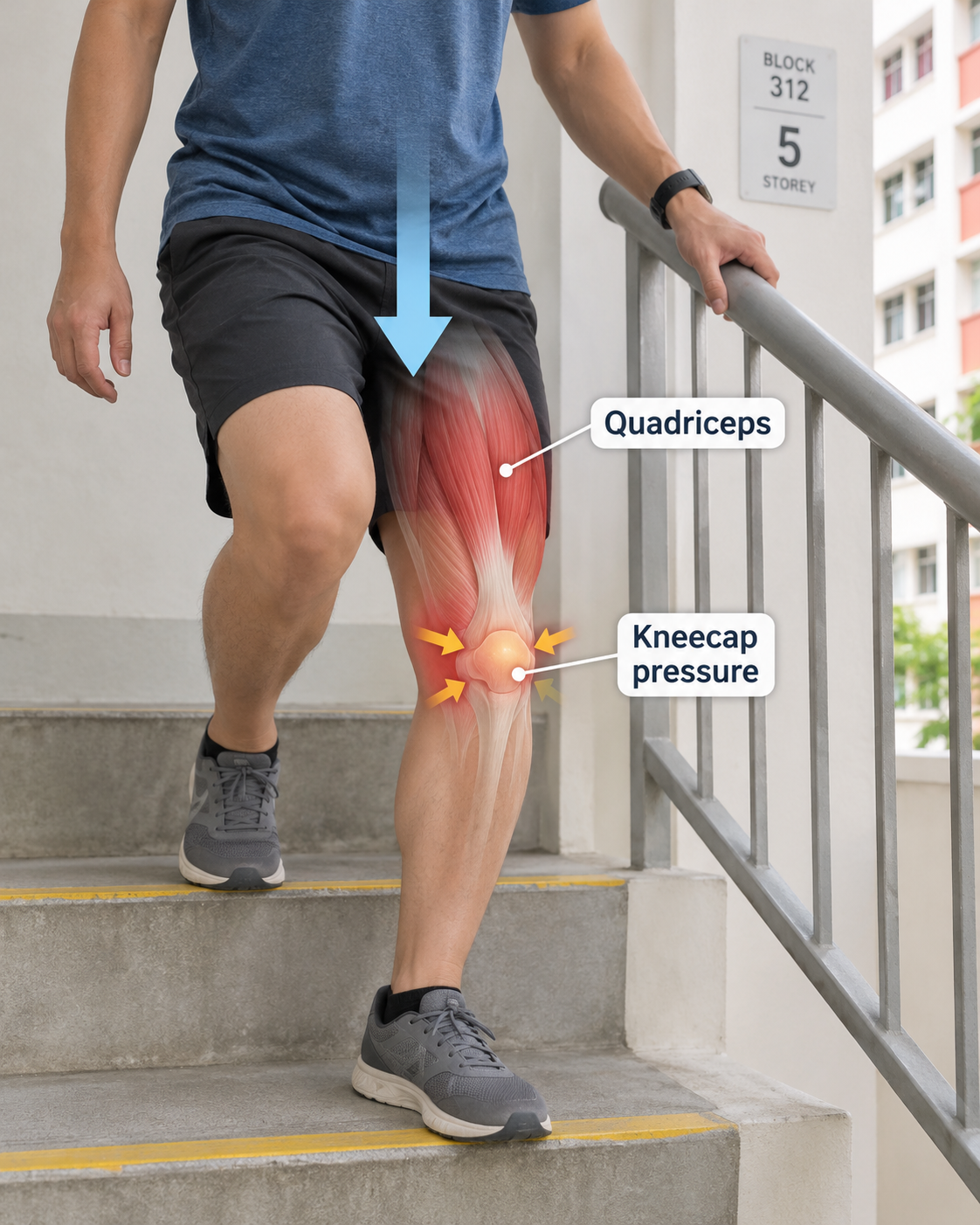
When descending stairs, your quadriceps (the muscles at the front of your thighs) work to control how quickly your body lowers onto the next step.
As your knee bends under your body weight, the pressure between your kneecap and thigh bone also increases. If your knee is sensitive to this load, descending stairs may become uncomfortable even when walking on flat ground feels normal.
One possible explanation is patellofemoral pain, which is discomfort around or behind the kneecap. It can occur in runners, active individuals and people who do not exercise regularly.
However, not every painful knee is caused by the kneecap. Osteoarthritis, tendon irritation and previous injuries can also contribute to discomfort during stair use.
You can explore these conditions in our guide to common knee problems.
What Can You Do About It?
If the discomfort is mild, reducing repeated stair use temporarily may help settle irritated tissues. Using a handrail and taking your time when descending can also make the activity more manageable.
Complete rest is not always necessary. Comfortable walking and suitable strengthening activities can help maintain your mobility while you recover.
Longer-term improvement often involves gradually rebuilding your knee's ability to tolerate everyday activities.
For some people, this means strengthening the quadriceps and hip muscles, or involve improving movement control or adjusting their activity levels.
The right approach depends on why your knee hurts in the first place.
When Should You See a Physiotherapist?
Consider an assessment if your knee pain keeps returning, gets progressively worse or starts affecting daily activities.
At MoveMed Physiotherapy, your physiotherapist can assess your knee movement, lower-limb strength and how you perform activities such as squatting or stepping down.
Rather than focusing on the painful area alone, the assessment helps identify what may be limiting your movement and guides a suitable therapeutic exercise programme.
If you cannot bear weight, your knee locks, or you develop significant swelling after an injury, seek prompt medical assessment. A hot, swollen knee accompanied by fever also requires urgent medical attention.
Knee pain should not have to dictate how you move through your day.
If descending stairs has become a regular problem, MoveMed Physiotherapy offers personalised assessment and rehabilitation at our Novena and Orchard clinics.
Contact MoveMed to arrange an appointment.
About MoveMed Physiotherapy Singapore
At MoveMed, we support your recovery through purposeful movement.
Our professionally trained physiotherapists at Novena and Orchard provide tailored sessions in a well-equipped facility—featuring treatment beds, shockwave therapy machines and more —to help you regain strength, mobility, and confidence.
Whether it’s pre-op rehab, pain management or post-op rehab, our team is here to guide your journey every step of the way.
📍(Orchard) Movemed Physiotherapy, 391B Orchard Road Ngee Ann City Office Tower B. #25-03 Singapore 238874
📍(Novena) MoveMed Physiotherapy, 10 Sinaran Dr, #09-04, Novena Medical Center, Singapore 307506
🌐www.movemedsg.com
📞 Call / WhatsApp: +65 9627 2000
📧 Email: hello@movemedsg.com
