
Shockwave Therapy vs Ultrasound
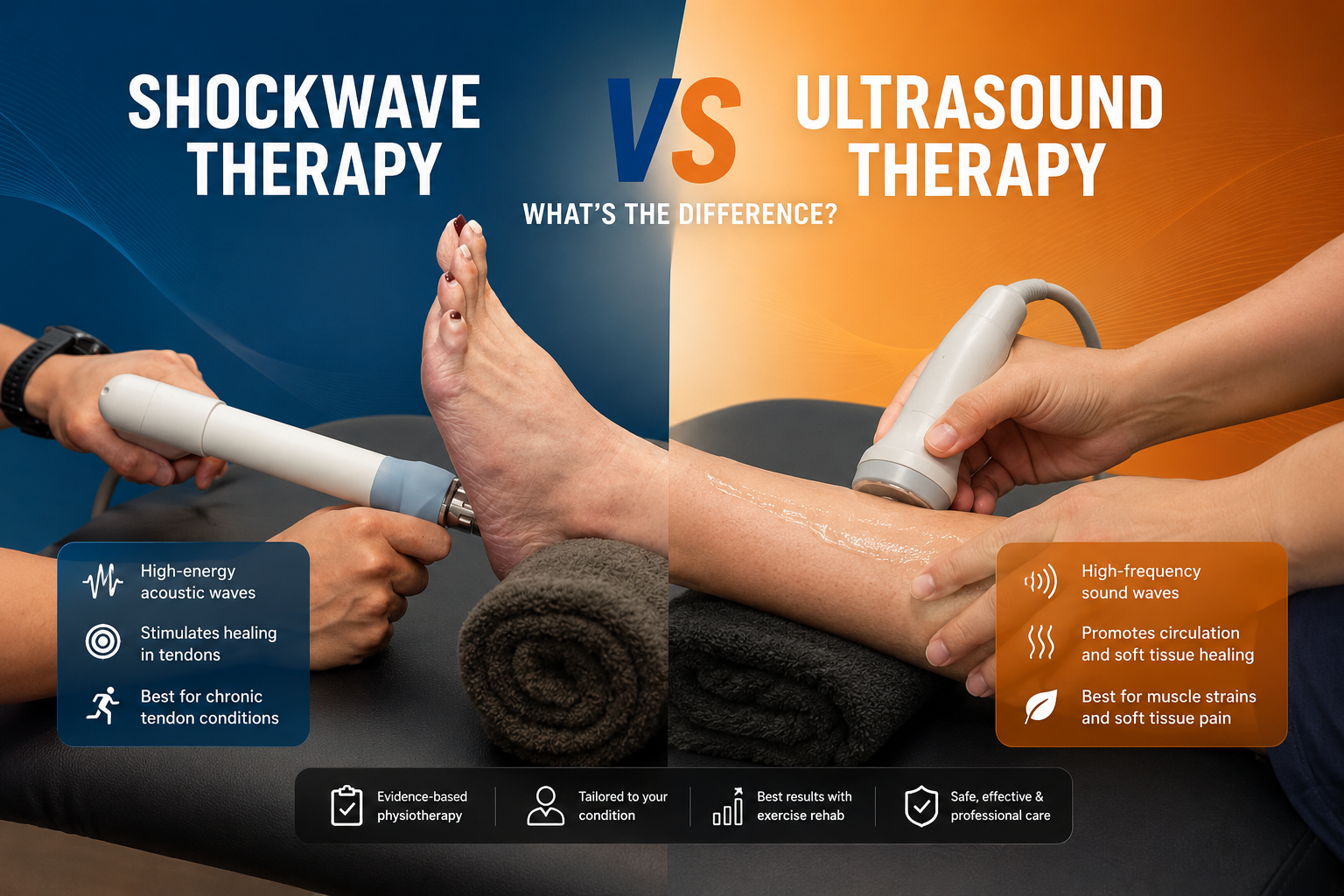
Shockwave Therapy vs Ultrasound
Shockwave Therapy vs Ultrasound Therapy: What's the Difference?
Shockwave therapy and therapeutic ultrasound are both used in physiotherapy, but they are not the same treatment. Although both involve forms of mechanical energy, they work differently, are typically selected for different clinical situations, and should be considered as part of a broader rehabilitation plan rather than as stand-alone solutions.
Patients may encounter either treatment when recovering from tendon problems, muscle injuries or persistent musculoskeletal pain. Understanding the difference can make it easier to understand why a physiotherapist may recommend one treatment rather than another.
What is Shockwave Therapy?
Shockwave therapy uses acoustic pressure waves that are directed into an injured or painful area. In physiotherapy, it is most commonly associated with persistent tendon-related conditions where symptoms have continued despite activity modification or rehabilitation.
The mechanical stimulation created by shockwave therapy is intended to encourage biological responses within the affected tissue. Depending on the condition, treatment may be used alongside progressive loading and strengthening exercises to support recovery.
Shockwave therapy may be considered for conditions such as:
- Achilles tendinopathy
- Plantar fasciitis
- Patellar tendinopathy
- Tennis elbow
- Calcific shoulder tendinopathy
- Other selected chronic tendon conditions
Treatment can sometimes feel uncomfortable because the acoustic pulses are delivered directly over the symptomatic tissue. The intensity can usually be adjusted according to the patient's tolerance and clinical requirements.
What is Ultrasound Therapy?
Therapeutic ultrasound uses high-frequency sound waves delivered through a small treatment head placed against the skin with ultrasound gel.
These sound waves can produce thermal and non-thermal effects within soft tissue. Depending on the settings selected by the physiotherapist, ultrasound may be used as an adjunct during rehabilitation for pain, stiffness or selected soft tissue conditions.
Therapeutic ultrasound should not be confused with diagnostic ultrasound. Diagnostic ultrasound creates images of structures inside the body, while therapeutic ultrasound is used as a treatment modality.
Quick Comparison: Shockwave Therapy vs Ultrasound Therapy
| Feature | Shockwave Therapy | Ultrasound Therapy |
|---|---|---|
| Energy Used | Acoustic pressure waves | High-frequency sound waves |
| Typical Use | Persistent tendon-related conditions | Selected soft tissue and rehabilitation applications |
| Sensation | Can cause mild to moderate discomfort | Usually painless; mild warmth may sometimes be felt |
| Mechanical Effect | More pronounced mechanical stimulation | Gentler thermal and non-thermal effects |
| Role in Rehabilitation | Adjunct to exercise and progressive loading | Adjunct to exercise, mobility and other treatment |
| Best Treatment? | Depends on the diagnosis, stage of recovery and clinical assessment. | |
Conditions Treated
Shockwave and ultrasound therapy can both appear in musculoskeletal rehabilitation, but they are generally selected for different reasons.
Conditions Commonly Associated With Shockwave Therapy
Shockwave therapy is particularly associated with persistent tendon pain and certain chronic soft tissue problems. Examples may include:
- Achilles tendinopathy
- Plantar fasciitis or persistent heel pain
- Patellar tendinopathy
- Lateral elbow tendinopathy or tennis elbow
- Calcific shoulder tendinopathy
Conditions Where Therapeutic Ultrasound May Be Used
Therapeutic ultrasound may sometimes be incorporated into rehabilitation for:
- Selected muscle strains
- Soft tissue stiffness
- Scar tissue management
- Selected ligament or tendon injuries
- Pain management as part of a wider treatment programme
The presence of a particular condition does not automatically mean that either modality is necessary. A physiotherapist will first assess the nature and stage of the injury before deciding whether an adjunct treatment is appropriate.
Can Shockwave and Ultrasound Therapy Be Used Together?
They can form part of the same overall rehabilitation programme, although this does not necessarily mean that both should be performed during every treatment session.
Physiotherapy commonly combines several approaches depending on the patient's needs. These may include:
- Progressive strengthening exercises
- Mobility exercises
- Manual therapy
- Activity and load modification
- Shockwave therapy
- Therapeutic ultrasound
- Education on recovery and symptom management
The modality is not the entire treatment
For many musculoskeletal conditions, improvements in strength, movement capacity and tolerance to activity require progressive rehabilitation. Modalities such as shockwave and ultrasound are therefore usually considered supportive treatments rather than replacements for exercise-based recovery.
How Does a Physiotherapist Decide Which Treatment to Use?
The decision should begin with an assessment rather than with the treatment machine itself. Two patients with pain in the same body region may have very different underlying problems and may therefore require different rehabilitation plans.
A physiotherapist may consider factors including:
- The diagnosis or likely source of symptoms
- How long the injury has been present
- Whether the problem involves tendon, muscle, ligament or another structure
- The patient's current pain and functional limitations
- Previous treatment and rehabilitation response
- Current activity level and rehabilitation goals
- Whether a modality is likely to add value to exercise-based rehabilitation
For example, persistent Achilles tendon pain that has not improved sufficiently with an appropriate loading programme may lead to a different treatment discussion from a recent muscle strain.
The most suitable approach is therefore not simply a question of whether shockwave therapy is "stronger" than ultrasound. It depends on whether the treatment matches the problem being treated.
Frequently Asked Questions
Is shockwave therapy the same as ultrasound therapy?
No. Both involve acoustic energy, but shockwave therapy produces distinct pressure waves and provides stronger mechanical stimulation. Therapeutic ultrasound uses high-frequency sound waves and produces different thermal and non-thermal tissue effects.
Which is better: shockwave therapy or ultrasound?
Neither treatment is universally better. The appropriate option depends on the condition, duration of symptoms, rehabilitation goals and clinical assessment. Shockwave therapy is commonly considered for selected persistent tendon conditions, while therapeutic ultrasound may be used for different soft tissue rehabilitation purposes.
Is shockwave therapy painful?
Some patients experience temporary discomfort while shockwave therapy is being applied, particularly when treatment is directed over a sensitive area. Treatment intensity can usually be adjusted according to tolerance.
Can you feel therapeutic ultrasound?
Therapeutic ultrasound is generally comfortable. Some patients may feel slight warmth, while others may feel very little during treatment.
How many shockwave therapy sessions are required?
The number of sessions varies according to the condition and individual response. Your physiotherapist can advise whether shockwave therapy is suitable and how it should be incorporated into your rehabilitation programme.
Will shockwave or ultrasound replace physiotherapy exercises?
Usually not. For many musculoskeletal conditions, progressive exercise, strength development and gradual return to activity remain important parts of rehabilitation. Modalities are typically used to complement this process.
Do I need shockwave therapy for tendon pain?
Not every tendon condition requires shockwave therapy. Assessment of the affected tendon, symptom duration, loading tolerance and previous rehabilitation is important before deciding whether it may be useful.
Choosing the Right Treatment for Your Recovery
Shockwave therapy and therapeutic ultrasound are different tools within physiotherapy. Shockwave therapy is often associated with persistent tendon problems and stronger mechanical stimulation, while therapeutic ultrasound provides gentler sound-wave treatment that may be incorporated into selected soft tissue rehabilitation programmes.
The most important consideration is not choosing a treatment based on the name of the modality, but understanding the underlying injury and developing a rehabilitation programme suited to your symptoms, goals and stage of recovery.
Unsure Which Treatment Is Suitable for You?
A physiotherapy assessment can help identify the likely cause of your symptoms and determine whether shockwave therapy, therapeutic ultrasound, exercise rehabilitation or another treatment approach may be appropriate.
Enquire With MoveMedAbout MoveMed Physiotherapy Singapore
At MoveMed, we support your recovery through purposeful movement.
Our professionally trained physiotherapists at Novena and Orchard provide tailored sessions in a well-equipped facility—featuring treatment beds, shockwave therapy machines and more —to help you regain strength, mobility, and confidence.
Whether it’s pre-op rehab, pain management or post-op rehab, our team is here to guide your journey every step of the way.
📍(Orchard) Movemed Physiotherapy, 391B Orchard Road Ngee Ann City Office Tower B. #25-03 Singapore 238874
📍(Novena) MoveMed Physiotherapy, 10 Sinaran Dr, #09-04, Novena Medical Center, Singapore 307506
🌐www.movemedsg.com
📞 Call / WhatsApp: +65 9627 2000
📧 Email: hello@movemedsg.com
