
Do I Need an MRI Before Physiotherapy?
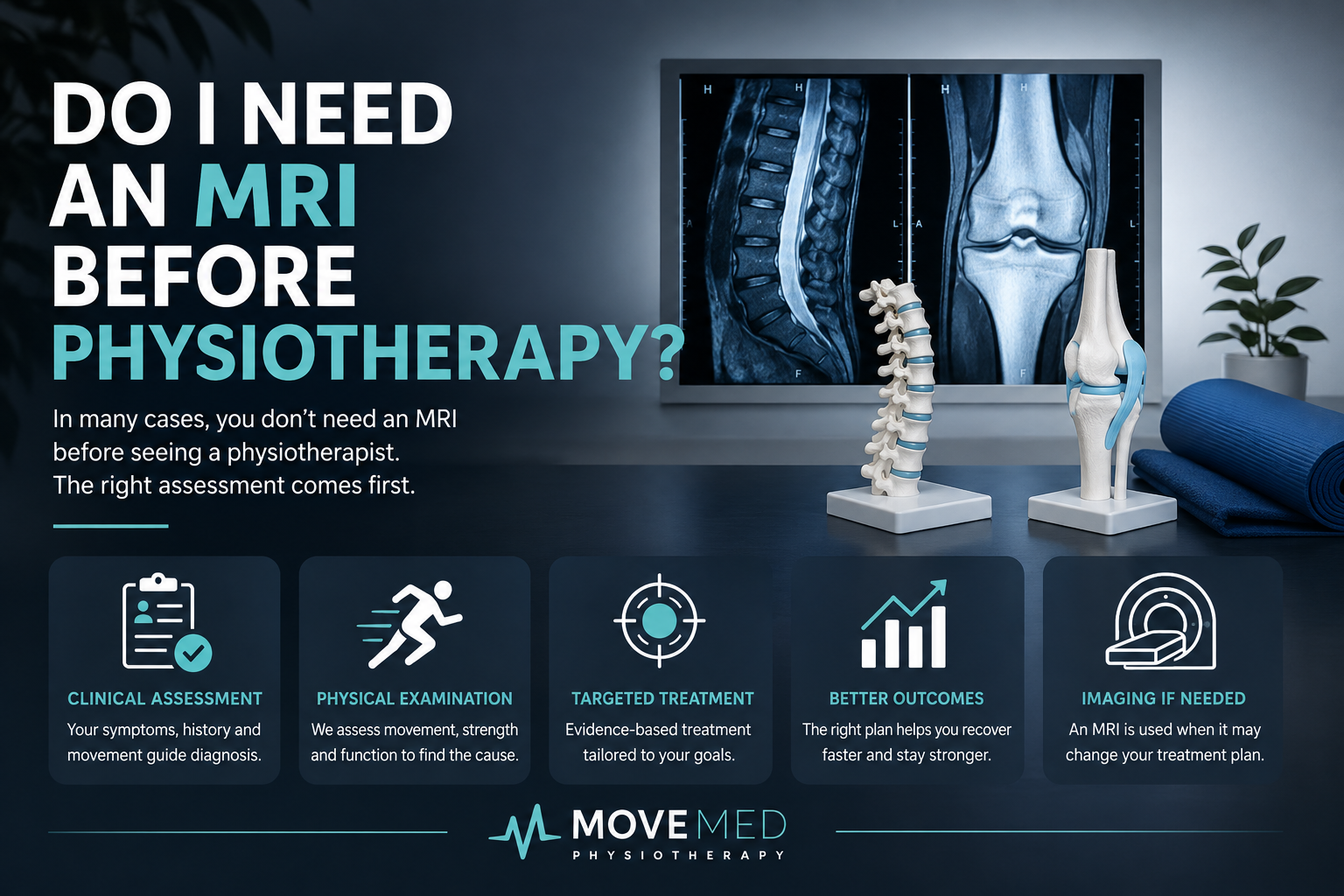
Do i need MRI before Physiotherapy
Do I Need an MRI Before Physiotherapy?
In many cases, you do not need an MRI before seeing a physiotherapist. Physiotherapists can assess many common musculoskeletal problems based on your symptoms, medical history, movement, strength and physical examination. Imaging may be useful when the findings could change how your condition is managed, but it is not automatically required before rehabilitation can begin.
It is common to assume that pain must first be "seen" on a scan before treatment can start. Someone with knee pain may wonder whether they have torn a ligament, while a person with back pain may be concerned about a slipped or herniated disc. An MRI can provide valuable information about structures inside the body, but imaging is only one part of understanding a musculoskeletal problem.
The more useful question is often not simply, "Do I need an MRI?" but "Would an MRI result change what we do next?"
Can I See a Physiotherapist Without an MRI?
Yes. Many patients can begin with a physiotherapy assessment without having an MRI beforehand.
During an initial assessment, a physiotherapist gathers information about how the problem started, where symptoms occur, what movements aggravate them and how the injury affects everyday activities, work or sport.
The physical examination may then assess areas such as:
- Joint movement and range of motion
- Muscle strength
- Balance and stability
- Walking or running mechanics
- Movement patterns
- Functional tasks relevant to your symptoms
- Specific clinical tests where appropriate
Together, these findings can often provide enough information to develop an initial rehabilitation plan without waiting for imaging.
An MRI is not a prerequisite for physiotherapy
A physiotherapy assessment focuses on what you can and cannot currently do, how your symptoms behave and which physical findings are relevant. In many common musculoskeletal conditions, rehabilitation can begin based on these findings even when no MRI has been performed.
What Does an MRI Actually Show?
Magnetic resonance imaging, or MRI, uses a strong magnetic field and radio waves to produce detailed images of structures inside the body. Unlike an X-ray, which is particularly useful for examining bones, an MRI can provide detailed images of many soft tissues.
Depending on the body region, an MRI may help visualise structures such as:
- Ligaments
- Tendons
- Muscles
- Cartilage
- Menisci in the knee
- Intervertebral discs
- Other soft tissue structures
This can be particularly useful when a healthcare professional needs more information about the extent or nature of an injury.
Why Isn't an MRI Always Needed Before Physiotherapy?
An MRI provides structural information, but physiotherapy decisions are not based on imaging alone.
Two people can have similar findings on an MRI while experiencing very different symptoms and levels of function. Conversely, someone can experience substantial pain or difficulty with movement even when imaging does not reveal a major structural injury.
This means that MRI findings need to be interpreted together with the patient's symptoms and clinical examination.
Imaging Findings Do Not Always Explain Pain
Structural changes can sometimes be present in people who have few or no symptoms. Findings such as age-related changes, disc changes or tendon changes therefore need to be considered in their clinical context rather than treated automatically as the cause of pain.
This is one reason why having an MRI before starting physiotherapy does not necessarily result in a better rehabilitation plan.
When Might an MRI Be Useful?
There are situations where imaging can provide important additional information. Whether an MRI is appropriate depends on the injury, examination findings, duration of symptoms and what information is needed to guide the next stage of care.
An MRI may be considered when:
- A significant structural injury is suspected
- Symptoms followed substantial trauma
- Symptoms are persistent or progressing despite appropriate management
- The clinical findings are unclear or unusual
- Surgery or another medical procedure is being considered
- Imaging results would meaningfully change the treatment plan
- A doctor or specialist requires additional diagnostic information
For example, imaging may form part of the assessment when there is concern about a significant ligament injury following a sporting incident. It may also be requested when symptoms have not progressed as expected and further investigation is required.
MRI First or Physiotherapy First?
There is no single answer that applies to every injury. The appropriate starting point depends on the circumstances.
| Situation | Possible Starting Point |
|---|---|
| Common muscle or joint pain without significant trauma | A physiotherapy assessment may be an appropriate first step. |
| Gradual onset of pain during exercise or activity | Assessment can help identify movement, strength and loading factors before deciding whether imaging is necessary. |
| Suspected significant ligament or structural injury | Medical assessment and imaging may be considered depending on the clinical findings. |
| Symptoms not improving as expected | Further assessment or imaging may be considered if the result could alter management. |
| Surgery is being considered | Imaging is commonly used as part of specialist assessment and surgical planning. |
| You already have an MRI | Bring the report and available images to your physiotherapy appointment so they can be considered alongside the clinical assessment. |
Do I Need an MRI for Knee Pain?
Not every case of knee pain requires an MRI. Knee symptoms can arise from many different structures and may be influenced by strength, training load, movement capacity and previous injury.
A physiotherapy assessment can examine knee movement, strength, swelling, stability and functional tasks such as walking, squatting, running or changing direction.
If the history and examination suggest that a more significant internal knee injury may be present, further medical assessment or imaging can then be considered.
What About a Suspected ACL or Meniscus Injury?
Following a twisting or sporting injury, the mechanism of injury and physical examination can provide important information about the knee. An MRI may subsequently be requested to investigate structures such as the ACL, meniscus, cartilage or other ligaments, particularly when the result is relevant to treatment or surgical decision-making.
However, having a suspected ACL or meniscus injury does not necessarily mean that all rehabilitation must stop until the MRI is completed. Depending on the individual situation, appropriate early rehabilitation may address swelling, movement, strength and function while further investigations are arranged.
Do I Need an MRI for Back Pain?
Most episodes of back pain do not automatically require an MRI before physiotherapy. A clinical assessment can examine how symptoms behave, movement tolerance, strength, neurological symptoms and the activities that aggravate or relieve the problem.
MRI scans of the spine can reveal structural changes such as disc degeneration, disc bulges and other age-related findings. However, these findings need to be interpreted carefully because structural changes do not always correspond directly with a person's pain.
Imaging may become more relevant when the clinical presentation suggests that further medical investigation is required or when symptoms are not following an expected recovery pattern.
Do I Need an MRI for Shoulder Pain?
Shoulder pain can arise from several structures and can also be influenced by strength, mobility, load and movement patterns. An MRI is therefore not automatically necessary before beginning physiotherapy.
A physiotherapist may assess shoulder range of motion, strength, pain response and functional movements before determining the appropriate rehabilitation approach.
Imaging may be considered when there is concern about a significant structural injury, when symptoms persist despite appropriate rehabilitation, or when specialist or surgical assessment is being considered.
What Happens If My Physiotherapist Thinks I Need Imaging?
Physiotherapy assessment does not mean that imaging will never be necessary. Rather, assessment can help determine whether additional investigation is likely to be useful.
If your symptoms or examination findings suggest that further medical investigation is appropriate, your physiotherapist may recommend that you consult a doctor or relevant specialist for further assessment and imaging where indicated.
This creates a more useful sequence:
Assessment → Clinical Question → Imaging When Needed
Instead of obtaining an MRI simply because pain is present, imaging is most useful when there is a specific clinical question that the scan can help answer and when that information could influence the next stage of treatment.
Can Physiotherapy Start While Waiting for an MRI?
In some situations, yes. Whether rehabilitation should begin depends on the suspected injury, your symptoms and the findings from your assessment.
Where appropriate, early physiotherapy may focus on areas such as:
- Managing pain and swelling
- Restoring comfortable movement
- Maintaining or rebuilding strength
- Adjusting activities that aggravate symptoms
- Maintaining general physical capacity
- Preparing for later stages of rehabilitation
If assessment identifies features that require medical investigation first, the rehabilitation plan can instead be adjusted accordingly.
What If I Already Have an MRI Report?
If you have already undergone an MRI, bring the report and any available images to your physiotherapy appointment.
Your physiotherapist can consider the imaging findings together with your symptoms and physical examination. This is important because rehabilitation should address the problems affecting your function rather than simply treating every term listed on an imaging report.
For example, an MRI may identify a structural change, but the physiotherapy assessment can help determine how that finding relates to your current strength, movement, pain and ability to perform everyday or sporting activities.
Frequently Asked Questions
Do I need an MRI before my first physiotherapy appointment?
Usually not. Many musculoskeletal conditions can first be assessed through your history and a physical examination. If imaging appears necessary based on the findings, further medical assessment can then be recommended.
Can a physiotherapist diagnose an injury without an MRI?
Physiotherapists use clinical assessment to evaluate musculoskeletal problems and identify findings relevant to rehabilitation. Some conditions may require imaging or medical investigation for further diagnostic information, but an MRI is not required for every injury before physiotherapy can begin.
Does an MRI show the exact cause of pain?
Not necessarily. MRI scans show structural findings, but not every structural change causes symptoms. Imaging therefore needs to be interpreted alongside your history, symptoms and physical examination.
Should I get an MRI for knee pain before physiotherapy?
Not automatically. Many knee problems can first be assessed clinically. Imaging may be considered when a significant structural injury is suspected, symptoms persist unexpectedly, or the result could affect treatment decisions.
Do I need an MRI for a suspected ACL tear?
Clinical assessment can provide important information about knee stability and the mechanism of injury. An MRI may then be used to provide further information about the ACL and other structures when appropriate, particularly when treatment or surgical decisions require it.
Can I do physiotherapy while waiting for my MRI?
In many cases, appropriate rehabilitation can begin while further investigation is being arranged. What is suitable depends on the suspected injury and assessment findings, so your programme should be adapted to your individual situation.
Should I bring my MRI report to physiotherapy?
Yes. If you already have an MRI report or other imaging, bringing it to your appointment allows the physiotherapist to consider those findings alongside your symptoms and physical examination.
So, Should You Get an MRI Before Physiotherapy?
For many common muscle, joint and tendon problems, an MRI is not required before your first physiotherapy appointment. Starting with a clinical assessment can help determine what is affecting your movement and function and whether rehabilitation can begin immediately.
Imaging becomes more useful when there is a specific reason to investigate further — particularly when a significant structural injury is suspected, the clinical picture is unclear, recovery is not progressing as expected, or the result could change medical or surgical management.
Ultimately, an MRI and a physiotherapy assessment answer different questions. Imaging shows structures, while clinical assessment examines how the problem is affecting you. When imaging is necessary, the two can be used together to guide the next stage of recovery.
Not Sure Whether You Need a Scan First?
A physiotherapy assessment can help evaluate your symptoms, movement and function and determine whether rehabilitation can begin or whether further medical investigation may be appropriate.
Enquire With MoveMedAbout MoveMed Physiotherapy Singapore
At MoveMed, we support your recovery through purposeful movement.
Our professionally trained physiotherapists at Novena and Orchard provide tailored sessions in a well-equipped facility—featuring treatment beds, shockwave therapy machines and more —to help you regain strength, mobility, and confidence.
Whether it’s pre-op rehab, pain management or post-op rehab, our team is here to guide your journey every step of the way.
📍(Orchard) Movemed Physiotherapy, 391B Orchard Road Ngee Ann City Office Tower B. #25-03 Singapore 238874
📍(Novena) MoveMed Physiotherapy, 10 Sinaran Dr, #09-04, Novena Medical Center, Singapore 307506
🌐www.movemedsg.com
📞 Call / WhatsApp: +65 9627 2000
📧 Email: hello@movemedsg.com
