
Private vs Hospital Rehabilitation
Physiotherapy Exercises
Private vs Hospital Rehabilitation: Which Is Right for Your Recovery?
Recovering from an injury or surgery often raises an important question: Should I continue rehabilitation at a hospital, or would private physiotherapy be a better option?
The answer depends on several factors, including your injury, recovery goals, budget, and the level of support you need throughout rehabilitation.
Both hospital and private rehabilitation play valuable roles in helping patients recover safely. Understanding the differences can help you make an informed decision that suits your circumstances.
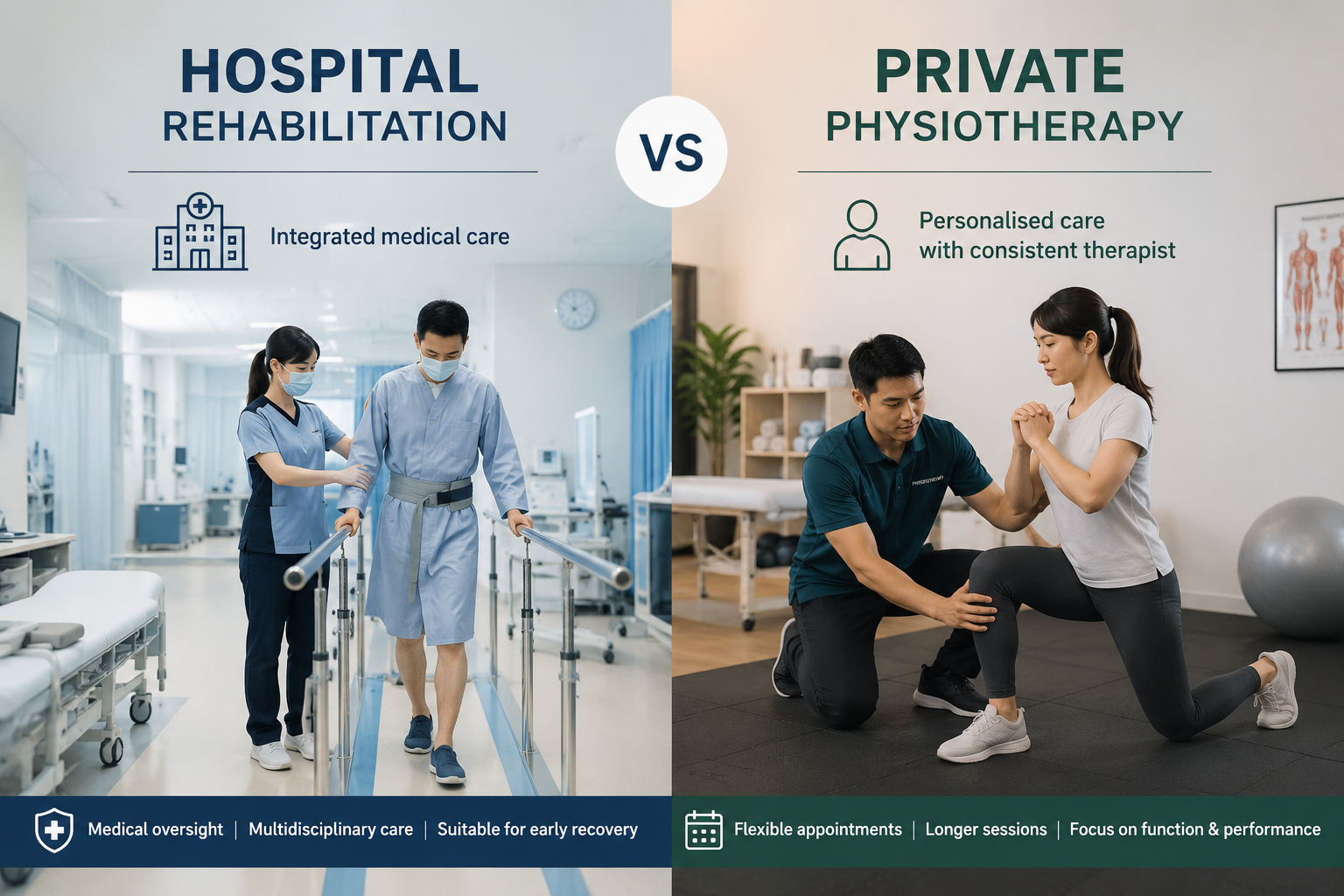
Hospital Rehabilitation vs Private Physiotherapy
Both settings can play an important role in recovery. The differences often relate to timing, continuity, flexibility and rehabilitation goals.
| Hospital Rehabilitation | Private Physiotherapy |
|---|---|
| Often begins immediately after surgery | Can begin after referral or direct booking where appropriate |
| Closely integrated with hospital medical teams | Individualised rehabilitation with consistent therapist follow-up |
| Focuses on safe early recovery | Focuses on restoring higher levels of function and performance |
| Appointment availability may vary | Greater flexibility in appointment scheduling |
| May involve different therapists between visits | Often managed by the same physiotherapist throughout recovery |
| Subsidised in public healthcare settings where applicable | Private consultation fees apply |
Neither approach is universally better. The most appropriate choice depends on your stage of recovery, medical needs, rehabilitation goals, preferred level of support and budget.
Which Rehabilitation Setting May Be More Suitable?
Your medical needs, stage of recovery and personal goals can help determine whether hospital rehabilitation or private physiotherapy is more appropriate.
| Hospital Rehabilitation May Be More Suitable If You: | Private Physiotherapy May Be More Suitable If You: |
|---|---|
| Have recently undergone surgery | Want shorter waiting times or greater appointment flexibility |
| Require close medical supervision | Prefer longer or more individualised treatment sessions |
| Have multiple medical conditions | Wish to work consistently with the same physiotherapist |
| Need coordinated multidisciplinary care | Have plateaued or require more targeted progression |
| Are recovering from major trauma | Are returning to recreational or competitive sport |
| Require inpatient rehabilitation or substantial mobility assistance | Need rehabilitation tailored to your occupation, lifestyle or performance goals |
Hospital rehabilitation: Your surgeon or medical team may recommend continuing hospital physiotherapy until your condition is medically stable and your recovery has reached an appropriate stage.
Private physiotherapy: Many patients transition to private care after the initial hospital phase when they require continued strengthening, functional rehabilitation or a more personalised return-to-activity programme.
Can You Use Both?
Yes.
In many cases, rehabilitation is not an "either-or" decision.
Many patients receive rehabilitation in both settings throughout different stages of recovery.
For example:
Stage 1
Hospital physiotherapy immediately after ACL reconstruction focuses on protecting the graft, reducing swelling and restoring knee movement.
↓
Stage 2
Private physiotherapy may focus on rebuilding strength, improving balance, retraining movement patterns and preparing for return to sport.
Both stages complement one another rather than compete.
What Happens During Rehabilitation?
Whether rehabilitation takes place in a hospital or private clinic, treatment usually progresses through several stages. The exact programme depends on your condition, surgery, symptoms and recovery goals.
Early Phase
Protect and Restore
- Pain and swelling management
- Protection of healing tissues
- Restoration of joint movement
- Walking and mobility retraining
Middle Phase
Rebuild Strength
- Progressive muscle strengthening
- Improvement of flexibility
- Balance and coordination training
- Functional movement practice
Late Phase
Return to Activity
- Sport-specific exercises
- Running and impact progression
- Agility and movement drills
- Return-to-work preparation
- Injury-prevention strategies
Recovery is not based on time alone. Your physiotherapist may also assess swelling, movement, strength, balance, walking pattern and confidence before progressing you to the next stage.
Frequently Asked Questions
Common questions patients may have when deciding between hospital rehabilitation and private physiotherapy.
Is private physiotherapy better than hospital rehabilitation? +
Not necessarily. Hospital rehabilitation can be highly valuable during the early stages of recovery, particularly after surgery or a significant injury. Private physiotherapy may offer greater scheduling flexibility, continuity with the same therapist and more individualised progression during later stages.
Can I attend hospital and private physiotherapy at the same time? +
In some situations, patients may use both services. However, it is important that the rehabilitation programmes do not conflict. Share your exercise plans, surgical precautions and medical instructions with each physiotherapist so that your care remains coordinated.
When should I transition from hospital to private rehabilitation? +
Some patients transition after the immediate post-operative phase, while others continue hospital rehabilitation for longer. A transition may be considered when you require more frequent appointments, consistent therapist follow-up, advanced strengthening or sport-specific rehabilitation.
Will private physiotherapy help me recover faster? +
No rehabilitation setting can guarantee a faster recovery. Progress depends on factors such as your injury, surgical procedure, healing response, exercise consistency and appropriate progression. More frequent or individualised treatment may help address specific limitations, but recovery should not be rushed.
Do I need a referral for private physiotherapy? +
A referral may not always be required to book a private physiotherapy appointment. However, patients recovering after surgery should bring any relevant medical reports, imaging findings, surgical instructions and rehabilitation precautions provided by their doctor.
Should I stop hospital rehabilitation before seeing a private physiotherapist? +
You do not necessarily need to stop immediately. Speak with your healthcare team and consider how the two programmes will be coordinated. The aim should be to maintain a clear rehabilitation plan without unnecessary duplication or conflicting instructions.
About MoveMed Physiotherapy Singapore
At MoveMed, we support your recovery through purposeful movement.
Our professionally trained physiotherapists at Novena and Orchard provide tailored sessions in a well-equipped facility—featuring treatment beds, shockwave therapy machines and more —to help you regain strength, mobility, and confidence.
Whether it’s pre-op rehab, pain management or post-op rehab, our team is here to guide your journey every step of the way.
📍(Orchard) Movemed Physiotherapy, 391B Orchard Road Ngee Ann City Office Tower B. #25-03 Singapore 238874
📍(Novena) MoveMed Physiotherapy, 10 Sinaran Dr, #09-04, Novena Medical Center, Singapore 307506
🌐www.movemedsg.com
📞 Call / WhatsApp: +65 9627 2000
📧 Email: hello@movemedsg.com
