
How Long Does Physiotherapy Take to Work?

How Long Does Physiotherapy Take to Work?
One of the most common questions patients ask before starting treatment is:
“How long will physiotherapy take to work?”
The honest answer is: it depends. Recovery is influenced by the type of injury, its severity, how long it has been present, and how consistently rehabilitation is followed. While some people experience relief within days, others require a longer, structured recovery plan to achieve lasting improvement.
This article provides realistic expectations so patients understand what the physiotherapy journey looks like — and why patience and consistency matter just as much as treatment.
Why Recovery Time Varies
Physiotherapy focuses on restoring movement, reducing pain and improving function through targeted treatment and guided rehabilitation. Unlike painkillers that mask symptoms, physiotherapy addresses the root cause — and that process takes time.
Factors that influence recovery include:
Type of condition (acute vs chronic)
Severity of injury
How long the problem has existed
Patient age and physical condition
Lifestyle habits (work ergonomics, activity level)
Frequency of therapy and home exercise compliance
Typical Physiotherapy Timelines by Condition
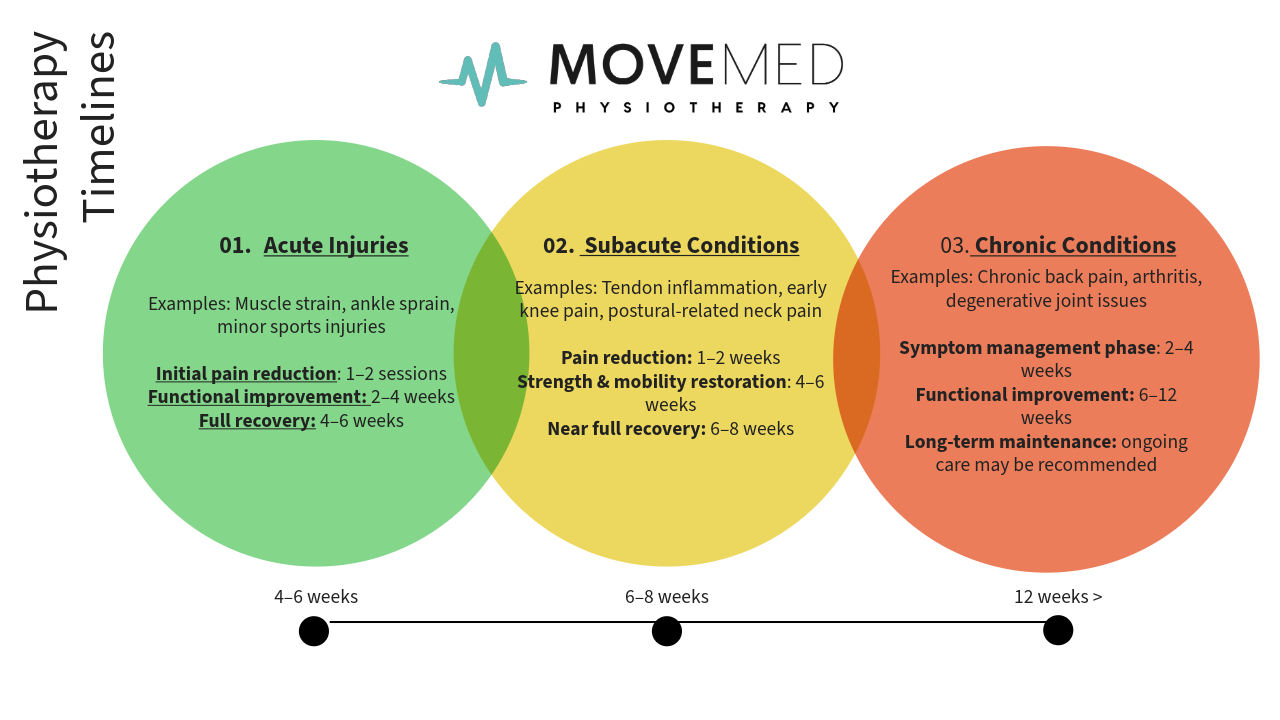
Physiotherapy Timelines
Typical Recovery Phases
Most physiotherapy journeys follow a progressive three-stage process. While these stages may overlap depending on the condition, they form the backbone of sustainable recovery and help patients understand why improvement takes time.
1. Pain Reduction Phase.
During this period, the main focus is on calming the irritated or injured area.
Treatment aims to reduce inflammation, relieve discomfort and restore basic movement so that daily activities become more manageable.
2. Rehabilitation Phase,
This involves strengthening weak or imbalanced muscles, correcting faulty movement patterns and improving flexibility and joint control. During this phase, treatment becomes more active, with progressive exercises and controlled loading of the affected area.
3.Prevention and Maintenance Phase.
Once pain has reduced and function has improved, the focus shifts towards preventing recurrence.
Education on posture, movement habits and lifestyle modifications becomes central. This phase is more individualised and may continue as part of long-term self-management, especially for those with recurrent or chronic conditions.
Signs Physiotherapy Is Working
Progress in physiotherapy is not always dramatic or immediate, but it manifests through gradual and meaningful improvements. Patients often notice that pain becomes less intense and less frequent over time. Movement starts to feel smoother, daily activities become easier and physical tasks that once caused discomfort begin to feel more manageable.
It is important to recognise that recovery is rarely perfectly linear.
Mild setbacks or temporary fluctuations can occur, especially as the body adapts to new movement patterns or exercise demands. These variations are normal and do not mean treatment is ineffective.
When Results May Take Longer
While many patients experience improvement within a reasonable timeframe, some conditions naturally require extended recovery periods. Progress may be slower when the issue has been present for a long time, when structural damage exists or when habits contributing to the condition remain unchanged.
Extended timelines are often seen when:
The injury or pain has been untreated for months or years
There is underlying joint degeneration or structural compromise
Other complications regarding the condition are hindering progress
Home exercise programmes are not followed consistently
Work or lifestyle patterns continue to aggravate the affected area
Posture and biomechanics are not corrected adequately
In such cases, a longer but structured rehabilitation plan helps ensure safe and stable improvement.
About MoveMed Physiotherapy Singapore
At MoveMed, we support your recovery through purposeful movement.
Our professionally trained physiotherapists at Novena provide tailored sessions in a well-equipped facility—featuring treatment beds, shockwave therapy machines and more —to help you regain strength, mobility, and confidence.
Whether it’s pre-op rehab, pain management or post-op rehab, our team is here to guide your journey every step of the way.
📞 Call / WhatsApp: +65 9627 2000
📧 Email: hello@movemedsg.com
Regain control. Move better. Live stronger.
